
How do you balance personalization and privacy on social media? This question is central to ethical digital design. In the UAE, where 94% of consumers avoid businesses with poor data protection, platforms must prioritize privacy while meeting user expectations for tailored experiences. The article explores how platforms like SureSpace and privacy-preserving AI methods achieve this balance.
Key Takeaways:
- UAE Regulations: Laws like Federal Decree-Law No. 55 of 2023 ensure data protection and ethical online practices.
- SureSpace Example: A UAE-based app that limits data collection, ensures user control, and complies with local standards.
- Privacy-Preserving AI: Techniques like federated learning, differential privacy, and homomorphic encryption safeguard data while enabling personalization.
- User Trust: Transparency and ethical advertising models strengthen trust and engagement.
The UAE’s regulatory framework and privacy-focused technologies are shaping a safer, more user-centric digital landscape. Platforms must prioritize transparency and user control to build trust and comply with local laws.
How Do You Ensure Data Security In Content Personalization? – Everyday-Networking
1. SureSpace Community App
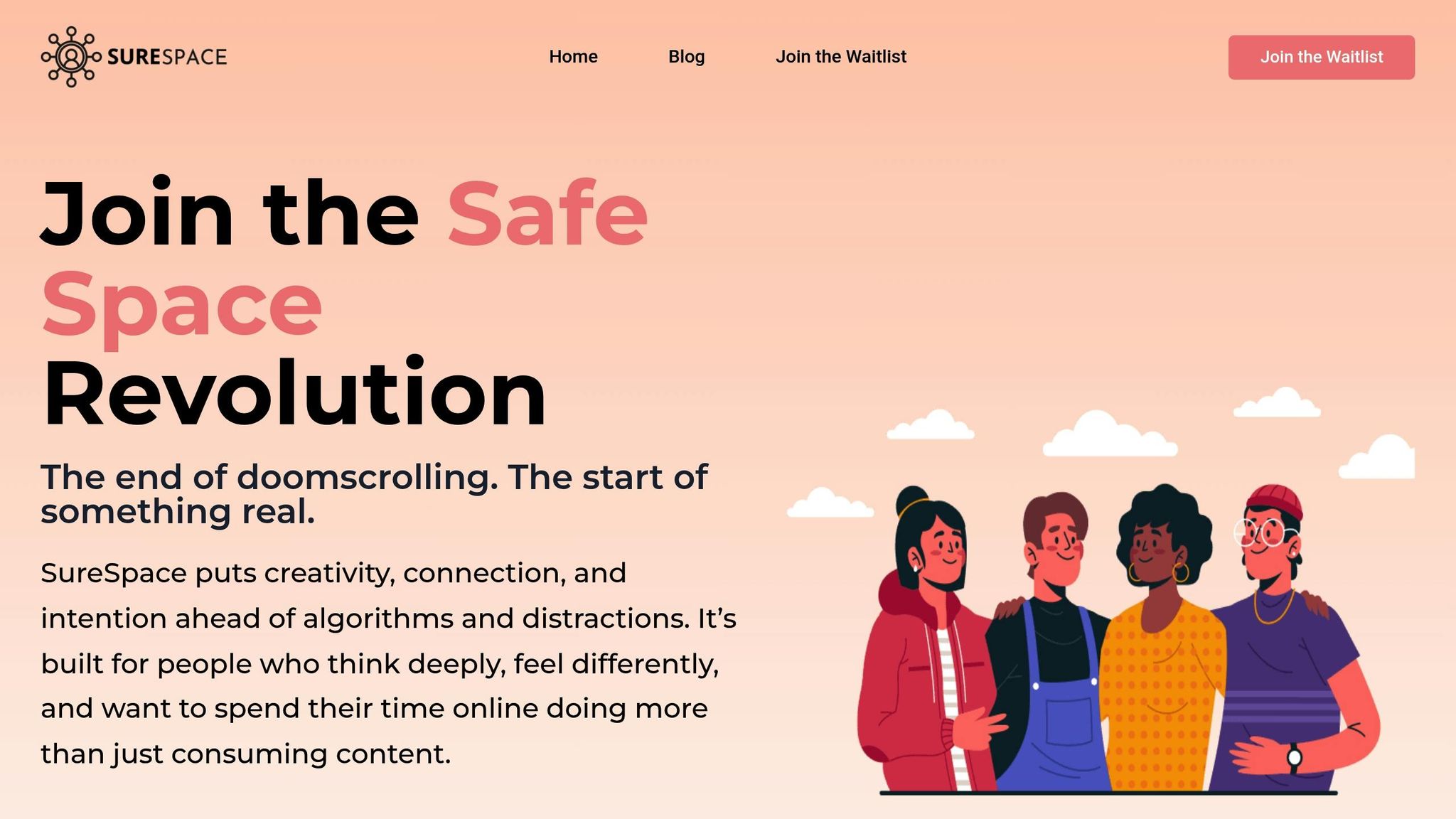
SureSpace Community App stands out as a platform that seamlessly blends privacy protection with meaningful personalisation. Guided by ethical design principles and operating under DIFC regulations, it caters to users aged 18 and above, ensuring their data is safeguarded while fostering genuine community connections. Unlike platforms driven by excessive data monetisation, SureSpace adopts a community-first approach that prioritises user trust and well-being.
Privacy Protection
SureSpace takes user privacy seriously. It collects only the data necessary to operate effectively, ensuring information is processed lawfully, fairly, and transparently. To keep user data secure, the platform employs encryption, rigorous access controls, and regular audits. Users have full control over AI features through their account settings and can opt out of AI-supported content creation at any time. Importantly, users retain intellectual property rights over the content they create.
The platform is transparent about data transfers, which are conducted under adequacy decisions or Standard Contractual Clauses. Any third parties involved are held to the same high-security standards. This robust approach to privacy not only protects user data but also lays the groundwork for a thoughtful and user-focused personalisation experience.
Level of Personalisation
SureSpace avoids intrusive personalisation practices that rely on extensive data collection. Instead, it focuses on enhancing community engagement by using only consented identity and technical data for marketing purposes. The platform follows a clear data retention policy, ensuring that AI-generated content isn’t stored indefinitely for profiling. This balanced approach lets users discover relevant content and build meaningful connections without compromising their privacy.
User Trust and Engagement
Trust is at the heart of SureSpace’s design. The platform’s revenue model avoids selling user data, relying instead on ethical advertising and premium features. This reinforces the idea that users are valued as community members, not commodities. SureSpace also provides tools to foster authentic connections and promote well-being, including mental health resources and content moderation features. These tools encourage a sense of community ownership and shared responsibility, creating a space where users feel safe and supported.
Compliance with Local Standards
SureSpace aligns with UAE data protection laws through comprehensive policies, procedures, and technical safeguards. Users are informed of their rights, such as access, rectification, erasure, data portability, and the ability to lodge complaints with the DIFC Commissioner of Data Protection. These rights are clearly outlined in the platform’s Privacy Notice.
This commitment to compliance positions SureSpace as a leader in the UAE’s regulatory environment, especially as social media usage in the region is expected to reach 112.5% by 2025. By adhering to local standards, the platform not only meets legal requirements but also builds a foundation of trust and reliability for its growing user base.
2. Privacy-Preserving AI Methods
SureSpace’s focus on community-driven design extends to advanced AI methods that carefully balance privacy and personalisation. With 70% of consumers expressing concerns about how their data is collected and used, privacy-preserving AI offers a solution that safeguards user data while delivering the personalised experiences people now expect.
Privacy Protection
Modern techniques in privacy-preserving AI are designed to secure user data without compromising functionality. For example, differential privacy introduces controlled noise to data, masking individual information while still enabling safe data analysis.
Federated learning takes another approach by training AI models directly on users’ devices. This method ensures that sensitive data stays local, while leveraging collective patterns to improve predictive accuracy. It’s particularly effective in commercial applications.
Meanwhile, homomorphic encryption allows computations to be performed on encrypted data, ensuring complete confidentiality. Although it’s computationally intensive, it offers unmatched privacy protection.
"Whenever you use online services, there are machine learning models operating in the background, collecting both your inputs and outputs. That compromises user privacy. Our goal is to bring FHE into the mainstream, and allow users to continue using the services they rely on everyday without releasing their personal, private data."
– Karthik Garimella, Ph.D student
Level of Personalisation
These privacy-focused methods don’t just protect data – they also enable businesses to deliver meaningful personalisation. Companies that use advanced anonymisation techniques report a 30% boost in personalisation accuracy while keeping user data secure.
A growing trend is the use of zero-party data, where platforms gather information directly through user-provided preferences, surveys, or feedback. A standout example is The New York Times, which launched its Perspective contextual targeting platform in 2023. By analysing article content instead of user data for ad placement, the platform achieved a 40% increase in engagement.
Different techniques strike unique balances between privacy and personalisation:
| Technique | Privacy Level | Personalisation Impact | Computational Cost |
|---|---|---|---|
| Differential Privacy | High | Moderate reduction | Medium |
| Federated Learning | Very High | Minimal reduction | High communication overhead |
| Homomorphic Encryption | Maximum | No reduction | Very High |
| Data Anonymisation | Medium | Low reduction | Low |
User Trust and Engagement
By adopting privacy-preserving AI, platforms can strengthen user trust. Studies show that 92% of consumers are more inclined to trust brands that clearly explain how their data is used. Unlike traditional AI systems that often collect data without explicit consent, these advanced methods embed transparency into their design, fostering stronger user relationships.
"The power of AI, especially advanced systems like generative AI and LLMs, can only be fully harnessed when user trust is established. By implementing strong privacy preservation methods, organisations can ensure they’re not only complying with regulations but also building a foundation of trust with their users."
– Privacera
Apple’s App Tracking Transparency initiative, introduced in 2023, is a prime example of this approach. By giving users control over their data, Apple boosted trust significantly. In fact, 80% to 90% of users opted out of app tracking when presented with the choice.
Compliance with Local Standards
The UAE’s regulatory framework strongly supports privacy-preserving AI. The country’s AI Ethics Guidelines emphasise transparency, accountability, and fairness in AI systems. Additionally, the DIFC Data Protection Regulations include Regulation 10, which specifically addresses the handling of personal data in autonomous systems. These privacy techniques align with these principles, ensuring ethical and transparent data processing.
"The UAE believes in the balance between protecting data privacy and fostering innovation in the economy."
– H.E. Omar Sultan Al Olama, Minister of State for Artificial Intelligence, Digital Economy and Remote Work Applications
Looking ahead, Gartner predicts that by 2025, 60% of large organisations will use AI to automate GDPR compliance, a significant rise from 20% in 2023. In the UAE, privacy-preserving AI not only helps organisations meet current regulations but also prepares them for future standards. For instance, Dubai’s AI Seal programme certifies AI businesses, ensuring they meet ethical and regulatory requirements, further reinforcing trust and compliance.
sbb-itb-a45ffa4
Pros and Cons
Building on the methods discussed earlier, let’s dive into the trade-offs between privacy and personalisation. For platforms like the SureSpace Community App, which emphasise ethical design principles, understanding these trade-offs is critical to delivering meaningful user experiences.
The relationship between personalisation and privacy is often described as the personalisation–privacy paradox. While 55% of users believe the benefits of personalisation outweigh potential privacy risks, 31% feel the risks are simply too great.
Traditional Personalisation vs. Privacy-Preserving Methods
Traditional personalisation methods typically rely on extensive data collection, which can clash with user expectations of privacy. On the other hand, privacy-preserving AI techniques offer a way to personalise content without compromising user data.
However, trust plays a huge role here. If personalisation feels intrusive, it can backfire – 38% of consumers say they’d stop engaging with a brand if its personalisation efforts seem “creepy”. This makes it clear that personalisation must tread carefully to avoid alienating users.
User Engagement Considerations
The balance between personalisation and privacy directly influences user engagement. While 71% of users value personalisation, 62% remain concerned about privacy. Platforms need to navigate these conflicting expectations carefully, especially since these dynamics often shape regulatory strategies in the UAE.
Compliance and Regulatory Alignment
In the UAE, privacy-preserving methods align more effectively with the country’s regulatory framework. The UAE’s Personal Data Protection Law (PDPL) focuses on principles like user consent, data minimisation, and purpose limitation. Additionally, privacy-preserving AI methods adhere to guidelines in the UAE Charter for the Development & Use of AI, which emphasises transparency, accountability, and fairness.
Trust and Transparency Benefits
Trust is a cornerstone of user engagement, and transparency is key to building it. Research shows that 86% of consumers want clearer information about how their data is handled, and 79% are more likely to trust brands that prioritise data protection. Privacy-preserving approaches can enhance transparency by reducing unnecessary data collection and promoting openness.
That said, adopting these methods often requires significant investment in technology and user education. Privacy-preserving techniques may also lead to a temporary dip in personalisation accuracy until systems are fine-tuned.
For platforms like SureSpace Community App, finding the right balance between personalisation and privacy is essential. By focusing on authentic connections and meaningful interactions, SureSpace naturally aligns with privacy-preserving approaches. This strategy not only builds trust through transparency but also reinforces the app’s commitment to ethical design, where user privacy and genuine engagement work hand in hand.
Conclusion
Designing ethical social media platforms is no longer just a moral responsibility – it’s also a smart business move. With 91% of users expressing concerns about how their data is used, yet 72% still expecting personalised experiences, the challenge for platforms is clear. Fast-growing companies already generate 40% more revenue through personalisation compared to their slower competitors. This highlights the pressing need for technologies that balance personalisation with robust privacy protections.
Privacy-preserving AI tools, such as federated learning and differential privacy, offer a promising solution. These technologies enable platforms to provide personalised content without compromising user data. As Professor Sandra Wachter from Oxford University‘s Internet Institute aptly puts it:
"Privacy-preserving AI will not merely be a technical solution but a fundamental rethinking of the relationship between consumers, their data, and the brands that serve them."
This philosophy aligns perfectly with platforms like SureSpace Community App, which prioritises creating authentic digital spaces over exploiting user data. By focusing on intentional interactions and putting control back in users’ hands, SureSpace exemplifies how ethical design can deliver personalised experiences while maintaining trust.
For companies, adopting privacy-by-design principles is essential. This means implementing transparent consent processes, conducting privacy-focused audits, and exploring technologies like federated learning. Pilot programmes using these methods can help demonstrate how personalisation and data protection can coexist. Open communication with users about these efforts is equally important. By showing the benefits users gain in exchange for their data, businesses can address the privacy–personalisation paradox and build a stronger foundation for digital engagement in the UAE.
As Rishad Tobaccowala puts it, platforms need to deliver "magic without the creepy". By embracing ethical design and prioritising trust, social media platforms can create meaningful, lasting connections with users while aligning with the UAE’s evolving regulatory standards. This approach isn’t just a recommendation – it’s a necessity for sustainable growth in today’s digital world.
FAQs
How does SureSpace protect user privacy while delivering personalised experiences in line with UAE data protection laws?
SureSpace places a strong emphasis on user privacy, fully complying with Federal Decree-Law No. 45 of 2021 on personal data protection in the UAE. We take every step to ensure that personal data is collected, processed, and stored with the utmost security, always respecting confidentiality and obtaining user consent.
Through advanced security protocols, SureSpace offers personalised features while maintaining strict privacy standards. This ensures user data remains protected, creating a secure and meaningful digital experience tailored to each individual.
What privacy-focused AI techniques are discussed in the article, and how do they build user trust?
The article delves into several privacy-preserving AI techniques like federated learning, homomorphic encryption, and differential privacy. These advanced methods enable social media platforms to process and analyse user data while keeping raw information hidden from exposure.
By protecting sensitive details and reducing the chances of data breaches, these technologies work to build trust and provide users with a sense of security, demonstrating that their privacy is being treated with utmost importance.
How can social media platforms create personalised experiences while safeguarding user privacy?
To balance personalisation with privacy, social media platforms need to embrace ethical design principles. This means being upfront about how they collect and use data, ensuring users provide clear and informed consent, and limiting data collection to only what’s truly necessary. Using anonymised data can also help deliver tailored experiences without risking individual privacy.
By focusing on building trust and respecting privacy, platforms can create a space for meaningful interactions while ensuring a secure and respectful online environment. This not only improves user satisfaction but also reflects responsible use of technology.

